UPDATES

Updates

Every release of OY.Surf since the first one, newest first. The app installs them for you when you quit; this is the record of what changed.

105 releases · 75 feature, 30 fix · 44 ship days · since Jun 12, 2026

LATEST
0.75.0
Sep 27, 2026 · 278 MB · Apple Silicon · notarized by Apple
Download for Mac

SEPTEMBER 20267 RELEASES

0.75.0
LatestNotarizedWas on the roadmap
278 MB Download

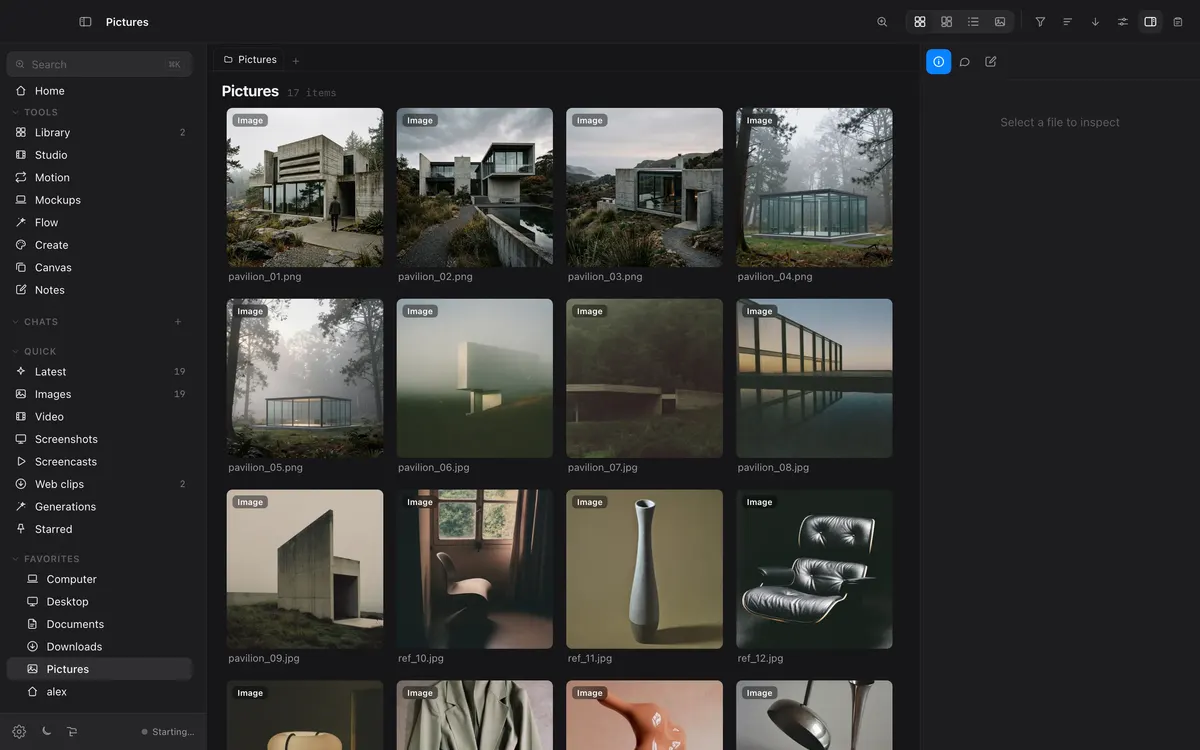
Studio, Motion and Mockups are one workspace

  • One frame for everything that plays in time. Studio now opens the way Motion and Mockups do: the whole window, ‹ Library at the top left, the same column widths, and Export at the right end of the timeline. It stays dark like the other two, and its accents are white instead of blue.
  • Mockups lines up with Motion. The left rail is the same width and scrolls on its own, so the thumbnails no longer run over the play button. The right panel is Canvas, Background and Device, each one collapsible, and the five export formats fit on one row.
  • Record and dictate straight from the notch. The Record tab starts with Screen, Window and Area. Screen starts recording at once with your Studio camera and microphone settings, and Area starts as soon as you have drawn one; OY.Surf steps out of the way so the take shows what you were looking at, and comes back with it when you press Stop. Window opens Studio with Window chosen, so you pick which one. The Dictate tab is one button: click to start, click again to stop, no key to hold. Clicking the notch brings OY.Surf forward, so that text is copied and saved to the list rather than pasted.
  • Dictation keeps what you said. Pressing again right after you stop no longer throws the second dictation away, and a result that arrives late can no longer end the one you are in the middle of. A microphone that drops out mid-sentence (AirPods switching away, a dock unplugged) used to leave dictation stuck until a restart; what it heard is transcribed now, and the next press works. Close the window mid-dictation and you are told, instead of watching Transcribing… forever.
  • The Dock brings the window back. After closing the window with ⌘W, clicking OY.Surf in the Dock opened nothing, because the clipboard panel counted as a window. It opens the window again.
  • A recording that ends on its own no longer looks like it is still going. If the capture stopped underneath Studio, it kept showing a take in progress with a Stop that could never finish. Now the take ends, you are told why, and the app comes back.
  • Videos always fit the viewer. A tall video could fill the screen with the controls laid over it, and there was no way to fit it. Every video now fits by its limiting side, with the controls in their own row underneath. Space plays and pauses, as the button’s tooltip always said.

StudioNotch & ClipboardMotion & MockupsLibrary & Lenses
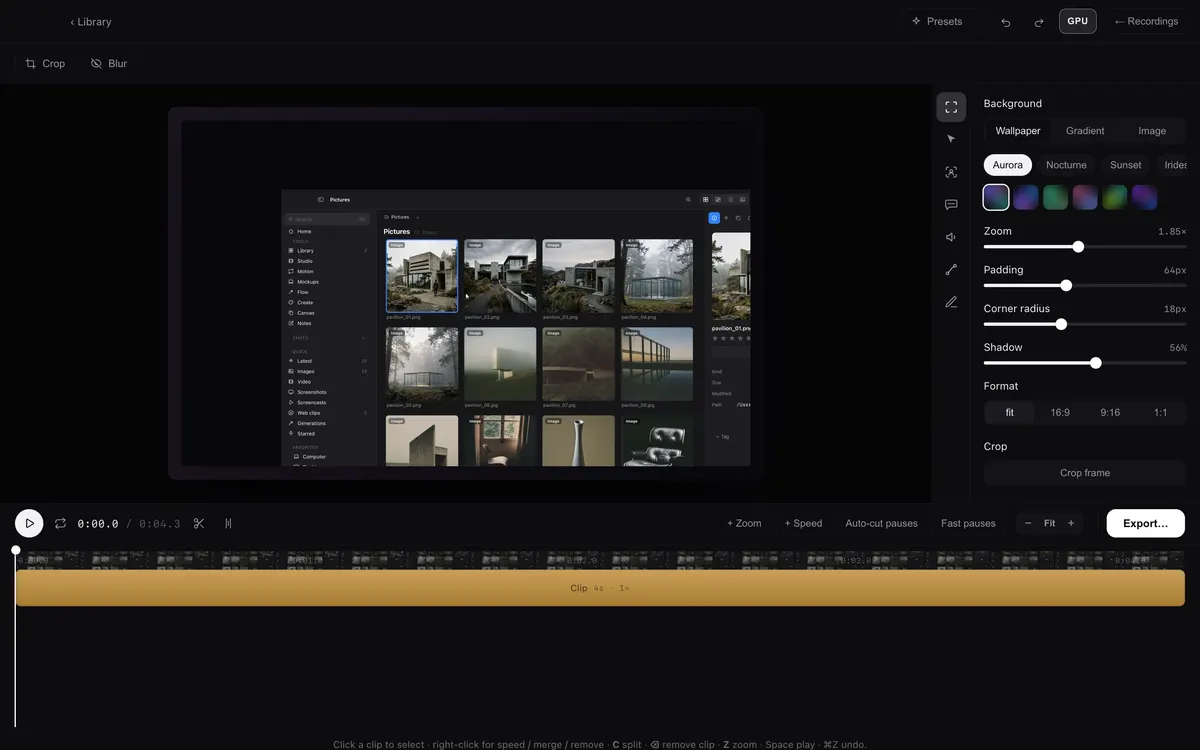
Studio editor with a take open, in the current app
FIG · Studio editor with a take open · the current app
0.74.0
Notarized
278 MB GitHub ↗

Your AI has never heard you. Now it has.

  • Own Your Voice. Every note you have ever dictated, distilled on this Mac into one file: the words you actually use, how you build a sentence, the positions you hold, what you are building right now. Open Flow › Voiceprint and press Build. Hand the file to Claude Code — or install the skill and switch the MCP server on, and it reads your voiceprint before it writes a word in your voice. It is made from your own recordings, by a model on your own machine, and it is never uploaded.
  • A recording that cannot be transcribed is no longer thrown away. This was already true for note recordings; now it is true everywhere. Push-to-talk and voice-to-prompt used to hand the audio over and delete it whether or not anything came back — a cold model or a timeout took the clip with it. The audio is kept instead, you are told so, and Settings › Dictation shows you where. Clips clear themselves after two weeks.
  • Silence stops inventing subtitles. The speech model answers a silent stretch with whatever end-card it saw most in training — “Thanks for watching”, and its Russian equivalents. Dictation has always filtered that out; recorded conversations, which have far more silence in them, never did, so invented credits could land in the middle of a real transcript. Fixed — and repeated-word loops are now caught in Russian too, which they never were.
  • The notch island is the size of what is in it. It opened as a strip: tabs, a search field, and nothing underneath however much was in the list. It was measuring itself mid-animation and believing the answer. It opens at a proper size now, and grows with the list until it scrolls.

Flow & NotesAsk & AgentsNotch & Clipboard

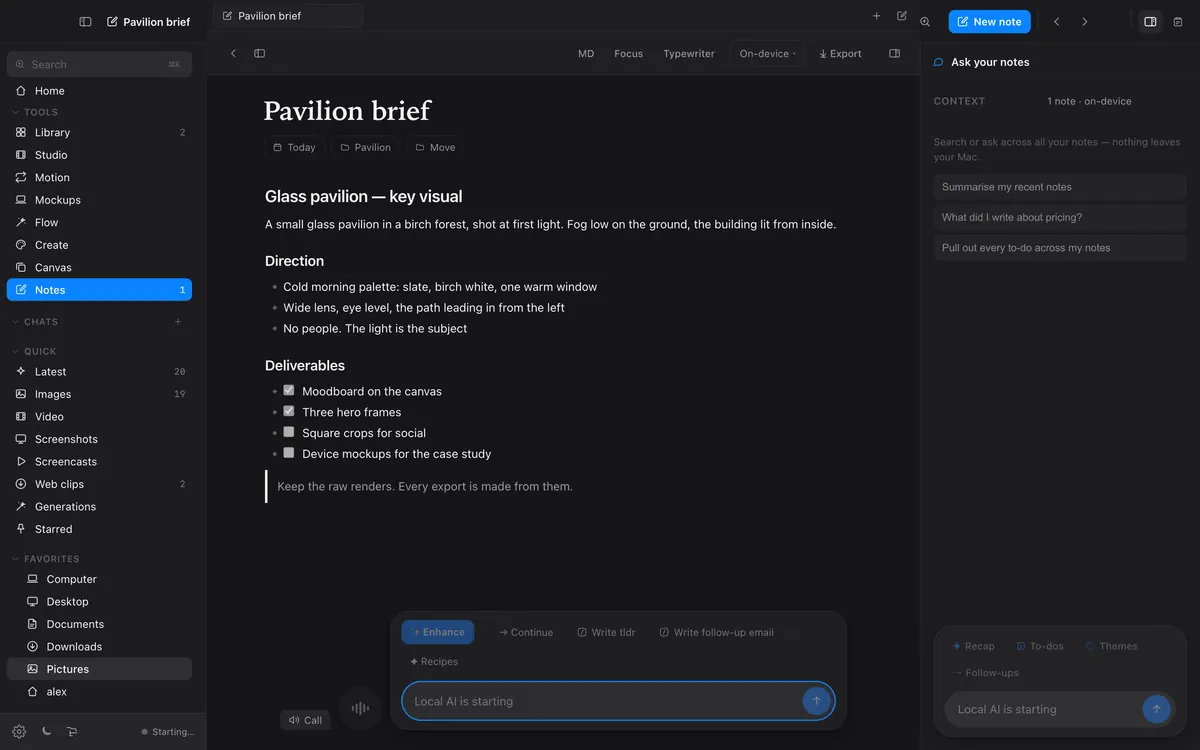
A note in Notes, in the current app
FIG · A note in Notes · the current app
0.73.0
Notarized
278 MB GitHub ↗

Your recording is a file, from the first second

  • A voice note can no longer be lost. Press record and the audio starts landing on disk immediately, next to the note, under a name you can read — not held in memory until the end. If the speech model times out, is still loading, or hears nothing at all, the recording is still there and the note says where. Transcribing is a separate step you can run again whenever you like.
  • Record the call, not just yourself. Switch on Call and a meeting is captured as two tracks: your microphone, and what the other people are saying. They stay separate on purpose — a mixdown could never be pulled apart again — and the two transcripts are merged by time into a labelled conversation, you and them. It cannot tell the people on the call apart from each other; that is a different problem and it is on the list.
  • Long recordings actually finish. A forty-minute note used to go to the speech model in one piece and give up. It is transcribed in chunks now, the way screen-recording captions already were.
  • Notch widget on other Macs. The island now follows the notch it is actually hanging from — its centre is re-read when you plug in a monitor or change scaling, and the strip that clears the camera is measured rather than assumed. On a Mac without a notch there is no longer a gap where the camera would be.

Flow & NotesNotch & Clipboard

0.72.0
Notarized
278 MB GitHub ↗

The notch holds the whole app now

  • Five sections, no detour. The buttons across the top of the island used to throw you into the app. They are the tabs now: everything you copied, your notes, your screen recordings, everything you dictated, and your recent files — each with its own list, and pressing one goes nowhere.
  • Pick a row and it does the obvious thing. A clipboard entry goes back on your clipboard, a note opens, a recording opens Studio already on that take, a file opens in the viewer with its thumbnail. Making something new lives on the + beside the search, and follows whichever section you are in.
  • It expands now, instead of dropping down. The island starts at the camera housing’s own size and opens outward with the small overshoot the platform gives this gesture. The text no longer rides that scale, so nothing squashes on the way out.
  • Smaller things you would have noticed. The scrollbar came through white on a black island — it is dark now; and the pale hairline across the top is gone, which was the window’s own rim showing against black.

Notch & Clipboard

0.72.1Sep 12The island closes the way it opened
  • It folds, it does not vanish. The notch widget grew out of the camera and then disappeared the instant your cursor crossed the edge — arriving and leaving by different paths, which reads as a glitch rather than a dismissal. It shrinks back into the housing now.
  • Change your mind and it waits. Move back onto it while it is folding and it stays — with whatever you had already typed into the search still there.
0.71.0
Notarized
278 MB GitHub ↗

Point at the notch

  • The notch is the button now. The menu-bar icon gets lost among a dozen others — so point at the camera housing instead, and the app grows out of it as a black island: everything you copied, everything you dictated, and your notes, over a row of the four things worth starting from the top of the screen.
  • Your notes, wherever they live. A new tab — newest first, with the first line or two of each, and picking one opens it. It is in the menu-bar panel too, not only in the island.
  • It stays out of your way. The hot spot is the notch and not a pixel more, it waits a moment before opening so passing through does nothing, and hovering never takes your keyboard — it only does that once you click into it.
  • No notch, no problem. On a Mac without one the same spot works at the top centre. Nothing is drawn until you point at it, so nothing ever covers your menu-bar icons.

Notch & Clipboard

0.70.0
Notarized
278 MB GitHub ↗

Your clipboard in the menu bar — and a teleprompter that never gets recorded

  • Clipboard, from any app. The history moves out of the title bar and into the menu bar, where a clipboard manager belongs: click the OY.Surf icon or press ⇧⌘V from whatever you are in, pick an entry, it is back on your clipboard. ⌥↵ pastes it straight into the field you came from. ⌘1–9 grab the first nine, Space is Quick Look on the highlighted one, ⌥P pins it above the line.
  • Dictations in the same panel. Everything you have said through Flow is the second tab — it has been kept all along, with nowhere to show it. Tab switches.
  • A teleprompter. Read a note or your clipboard to the camera from a window that floats over everything and never appears in a recording — not Studio’s, not anyone’s. Two presets: a strip under the built-in camera so your eyes stay where the viewer’s are, and a big mirrored one for a beam-splitter rig (⇧M if yours flips both ways). It counts you in — 3, 2, 1 — and holds the text until then; ⌃⌥Space plays and pauses from any app.
  • Where to find them. The Prompter button in a note, in Studio’s setup, on a board note’s menu, in ⌘K and in the tray. Both are in the ⌘/ cheatsheet and the welcome tour. The panel’s shortcut is a setting, for anyone already running Paste or Maccy.
  • One change to know. The menu-bar icon’s plain click now opens the panel; the command menu is on right-click, with the panel as its first item.

Notch & ClipboardStudioFlow & Notes

AUGUST 20269 RELEASES

0.69.0
Notarized
266 MB GitHub ↗

Everything you copied, one click away

  • Clipboard history. What you copy while OY.Surf is open is kept on this Mac — click the clipboard in the title bar, click a past copy, and it is back on your pasteboard. Copied images show as themselves, because for a screenshot the picture is the label.
  • Reach into it. The menu opens on a search field with the caret already in it: type to narrow, arrows to move, Enter to copy. ⌘⇧V from anywhere in the app. Pin the ones you keep going back to.
  • Not your passwords. Anything a password manager marks as a secret is never recorded, and the whole thing has a switch and a Clear in Settings.
  • Mockups. The “Import .glb” button had no styling at all and rendered as a plain system button on a black panel — it looks like the rest of the rail now.

Notch & ClipboardMotion & Mockups

0.69.1Sep 1The mockup skill stops waiting for itself
  • Screen mockup. The /screen-mock skill answered “coming soon” while Mockups had been doing exactly that for months. Run it on a screenshot now and Mockups opens with your picture already on the device screen, instead of an empty frame you then have to fill.
  • Under the hood. The checks a build has to pass before it can ship now open the surfaces one level down — Settings and every tab in it, the command palette, the shortcuts sheet, the clipboard menu — and each one has to prove it actually appeared. A surface that silently fails to open reports no errors and proves nothing, which is the trap the previous version of this check fell into.
0.68.0
Notarized
266 MB GitHub ↗

Dictation that stops failing — and light that lands

  • Dictation. “the system was briefly out of resources” was never the system: the app had run out of file descriptors and could no longer start its audio converter. The file watcher was holding an open handle for every file it watched — 18,856 of them on a single folder, against a ceiling of 10,240. It now costs one.
  • Mockups light. The rigs finally change the render. The key is a real softbox panel — which is what metal actually reflects — and its size is what “shadow soft” means. Products sit on a lit surface with a contact shadow instead of floating; worn and hung goods stay floating, as they should.
  • Ask. The Ask box in Flow and in the library was overlapping its own send button and clipping the placeholder. All three panels now use the same dock, and Flow gets the quick actions too.
  • Motion. The Card row no longer breaks “Face cam” and “No repeat” across two lines.
  • Clipper. A real app icon instead of a blank one.

Flow & NotesMotion & MockupsAsk & AgentsLibrary & Lenses
0.68.2Aug 25Studio stops fighting its own graphics check
  • Studio. Opening the editor was failing a check Pixi runs to find out how your GPU handles video — the app was blocking its own test clip, so the graphics path took a guess instead of the measured answer every single time.
  • Clipper. The Safari app has its own icon at last, instead of the placeholder Apple’s converter leaves behind, and opening it now explains what the Clipper does, whether it is on, and where clips land.
  • Under the hood. The release checks were quietly testing the wrong thing — they ran against a real profile and waited for a signal that is off by default. Both fixed, so a build has to prove itself on a clean install before it can ship.
0.68.1Aug 24Mockups models get their textures back
  • Mockups. The bundled models have been rendering untextured — the app was refusing to load their own textures, and their own maths fonts in notes, because its content rules did not allow resources it creates for itself. Both are allowed now.
  • How it was found. A new check walks every section of the built app before it can be published and fails on anything the app logs as an error. This was its first run.
0.67.0
NotarizedNot public yet
259 MB GitHub ↗

OY.Surf on iPhone — and a canvas that snaps

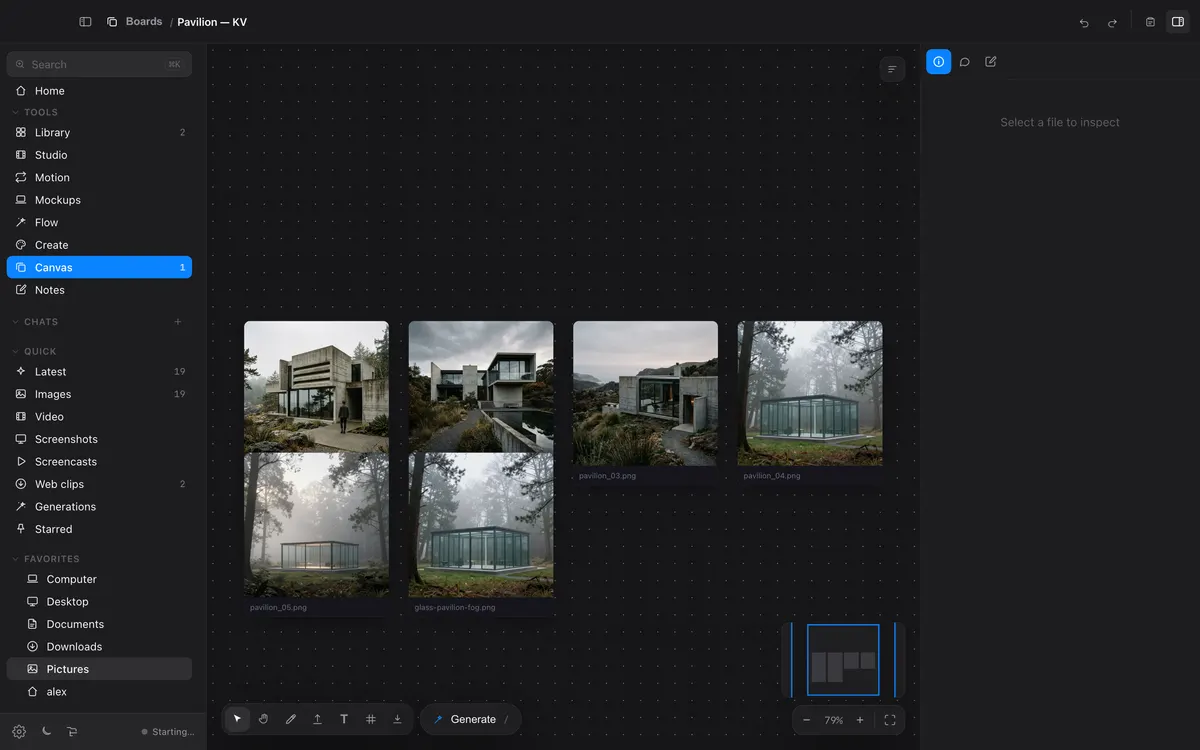
  • iPhone. The app now runs on the phone, not just the iPad: a canvas sized for the hand, one finger to move and resize, swipe from the edge to leave, and double tap to see the whole board.
  • Faster boards. Photos are decoded for the size they are drawn instead of the size they were shot — a 12 MP photo went from 46 MB in memory to 3 MB, which is the difference between a board that scrolls and one that stalls.
  • Snapping. Drag a picture near its neighbour and it lands flush on the edge or centre line, with the guide drawn and a tap of haptics — the same magnet at any zoom.
  • Mockups lighting. Key, fill and rim instead of a single lamp, with shadow softness and five named rigs — Studio, Soft box, Dramatic, Top down, Backlit.
  • Home. Motion and Mockups start from the home screen, and every tool in the sidebar now has a keyboard shortcut.

Not public yet: iPhone app: private testing

iPad & iPhoneCanvas & CreateMotion & Mockups

0.67.1Aug 17The build that could not open
  • Fixed. V0.67.0 could not launch at all — two native components never made it into the package. One of them had been failing quietly for longer than that, leaving vector search switched off.
  • Never again. A release now refuses to publish if the built app cannot start.
0.66.0
NotarizedNot public yet
278 MB GitHub ↗

Stepped motion, curved rings, mug & can — and share links

  • Motion. Stepped “ratchet” playback that snaps card to card, accelerating flicker cuts, and curved cards on the 3D ring.
  • Mockups. A mug and a soda can with real cylindrical printing — the art wraps the body — plus a framed poster and a business card; the camera reframes to suit each product.
  • Web version. Share links — one URL shows a client exactly one canvas, read-only — and a Docker deploy for self-hosting.
  • iPad. Share to OY.Surf from any app and pick the canvas right in the share sheet.

Not public yet: Web version: read-only share links · Self-host: Docker deploy · iPad app: share extension

Motion & MockupsCanvas & CreateiPad & iPhone

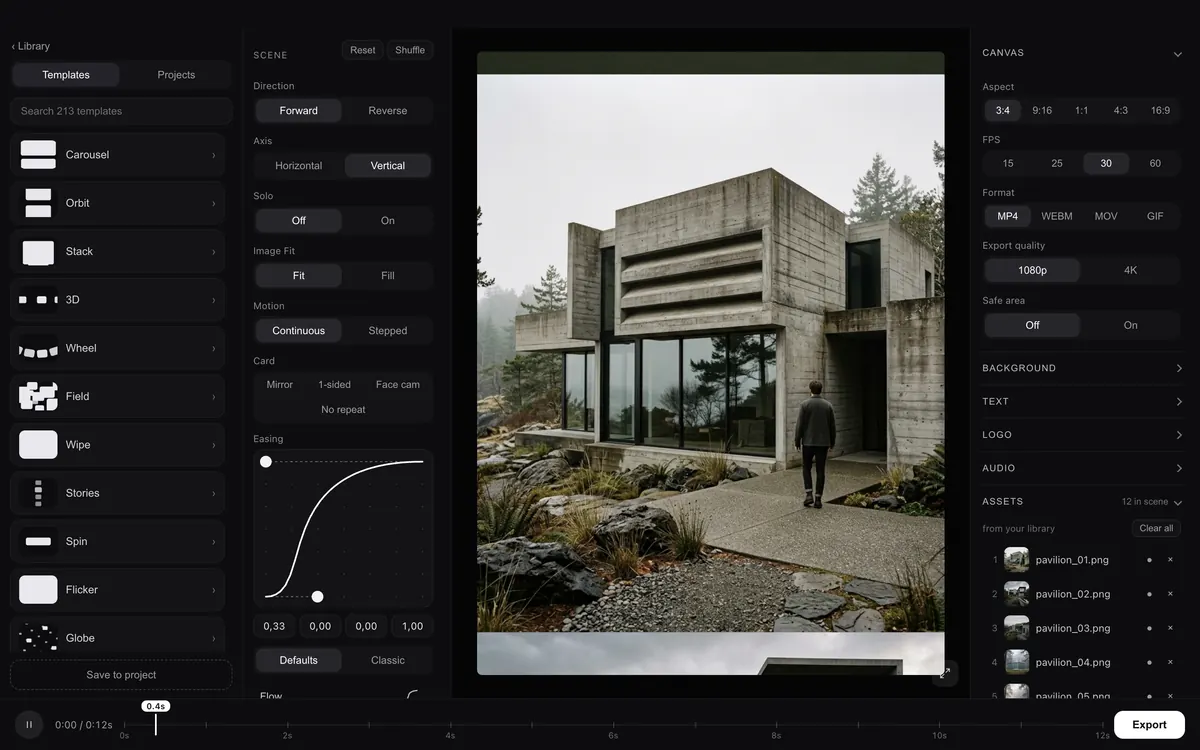
Motion with a template open, in the current app
FIG · Motion with a template open · the current app
0.65.0
278 MB GitHub ↗

Motion & Mockups — two new root tools

  • Motion. 200+ parametric templates that animate images from your library — carousels, orbits, wheels with hero images, a page-flipping magazine, vortexes and bento walls.
  • Preview = export. Bezier easing editor, text/logo/audio rendered into the file; 1080p or 4K H.264 — plus WebM/ProRes with alpha, GIF and transparent background.
  • Mockups. 3D device & apparel mockups — a MacBook that opens, a draped t-shirt and cap with your art on the fabric, studio light rig, waypoint timeline.
  • Everywhere. Live code-drawn hover previews, Projects that keep the whole look, Reset/Shuffle.

Motion & Mockups

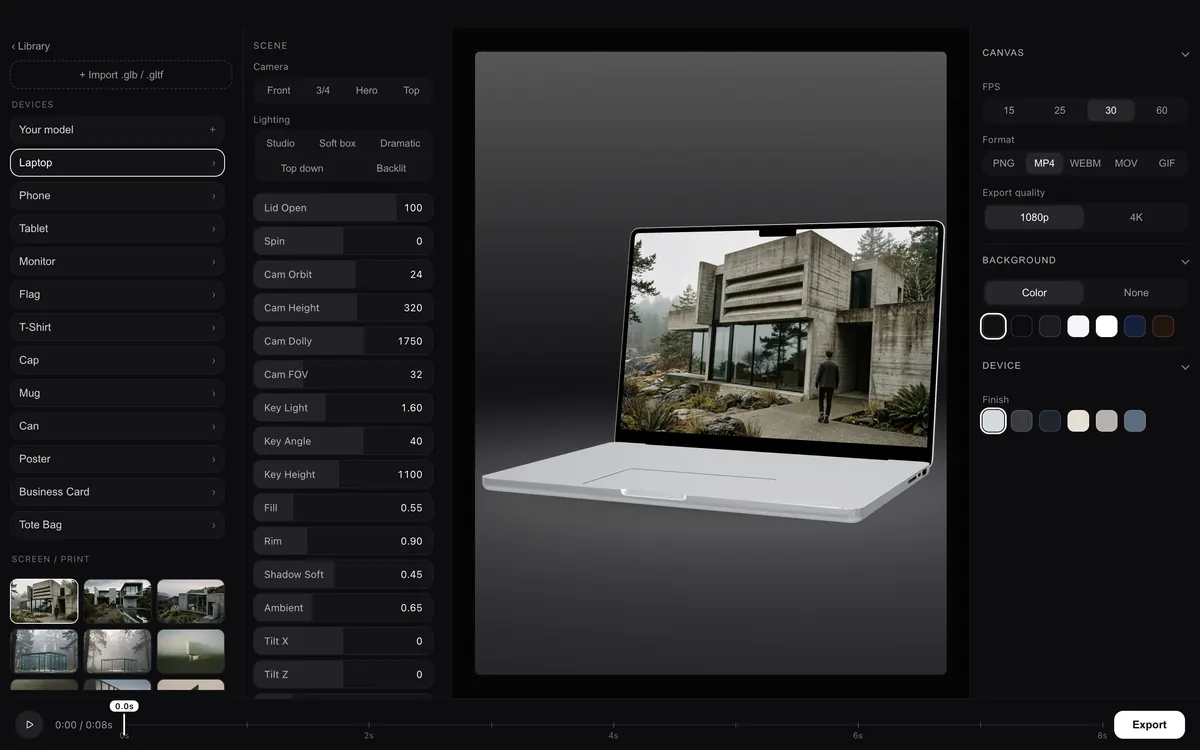
Mockups with a laptop scene, in the current app
FIG · Mockups with a laptop scene · the current app

JULY 202663 RELEASES

0.64.0
Notarized
263 MB GitHub ↗

Your tags — including the ones you built in Eagle

  • Tags, properly. Tag any file or a whole selection, filter the library by tag from the sidebar, and find things by tag in ordinary search — a partial tag on a selection shows as 3/8 and one click applies it to everything.
  • Import your Eagle library. Tags, folders, ratings, source links and item notes come across in one step from Settings → Library — your Eagle library is only read, never written, moved or copied, so Eagle keeps working exactly as before.
  • Imported notes are searchable immediately. Notes you wrote on items in Eagle land in the text index, so they turn up in search from the first minute.

Library & Lenses
Library with the Info lens, in the current app
FIG · Library with the Info lens · the current app
0.63.0
Notarized
263 MB GitHub ↗

The assistant, on every surface

  • Ask anywhere. The library assistant now answers from your notes, a single folder, your selection, the canvas, or your voice notes — scoped to whatever you're looking at.
  • A deep robustness pass. A full code review across the app fixed a migration that had quietly skipped audio, fonts and documents, hardened every local service, and tightened dictation.

Ask & AgentsFlow & Notes

0.63.10Jul 29Thumbnails that heal themselves
  • Missing previews come back. A preview that failed once used to stay blank forever — the library now retries, and files that arrived as cloud placeholders are picked up as soon as they download.
  • Huge renders finally preview. Multi-hundred-megapixel exports were silently refused; they now go through a low-memory path and get thumbnails like everything else.
  • A button that fit. The Export control in a note header no longer clips its own label.
0.63.9Jul 29Recordings export at their real resolution
  • 5K in, 5K out. The Studio editor composited every take at 720p, so a Retina recording exported soft — it now works at the recording's own resolution, up to 4K, and the "Best" preset keeps it.
  • Hardware encoding at 4K. The exporter asked for a codec profile that tops out at 1080p, quietly falling back to a slow software path — 4K60 now encodes on the GPU.
  • Sharper answers. Search results are re-ranked by a model that reads your question and each passage together, and descriptions and text-in-image are properly indexed instead of scanned.
  • Notes stay put. The note tab strip no longer slides under the window buttons, the last lines scroll clear of the AI dock, and the header stops spilling into the inspector.
0.63.8Jul 23A chat that streams, cites, edits — and knows your canvases
  • Answers as they're written. The on-device assistant now streams its reply word by word instead of making you wait for the whole thing.
  • Sources you can open. Every answer shows the files it actually drew on, as chips you click to open — check the claim, don't just trust it.
  • Ask about your canvases and past chats. Retrieval now covers your moodboards (their notes, captions and the images on them) and earlier conversations, not only files.
  • Edit from the chat. Type a slash on an attached image — /upscale, /remove-background, /beautify — and the on-device edit runs right there, result inline.
  • Dictation that never fights the GPU. A local generation in progress now steps aside for your voice, so push-to-talk stays instant even mid-render.
0.63.7Jul 21Ask streams its answers and names its sources
  • Answers as they are written. Ask shows the reply while the on-device model is still writing it, instead of making you wait for the whole answer. Before you type, the composer tells you if the engine is starting, switched off or has failed, rather than leaving you with an empty reply after you send.
  • Sources you can open. Answers show the files they name as chips you click to open, even when a file sits outside the folder you are browsing. A file is not credited just because its name matches part of a word, and when two files share a name, the chip shows which folder each one is in.
  • Fewer silent failures. A rename that cannot go through, or a move to Trash the system refuses, now shows an alert instead of quietly leaving things as they were. Deleting a dictation asks first, as deleting a chat or a board already did, and a batch edit on a canvas keeps your selection when it finishes.
0.63.6Jul 20Fluid, physical, Apple-native motion
  • Momentum where it belongs. The image viewer pans with real inertia and rubber-bands at the edges; menus and sheets now leave the way they arrived instead of blinking out.
  • Press feedback everywhere. Buttons respond to touch, popovers grow from what you clicked, and materials read as one four-step depth scale.
  • Respects your settings. Full support for Reduce Motion, Reduce Transparency and Increase Contrast.
0.63.5Jul 19Edit any image without leaving the viewer
  • Crop, flip, rotate, adjust. The on-device edits from the canvas — plus upscale, remove-background and beautify — now live in the fullscreen viewer and the grid's right-click menu, non-destructive, saved to Create.
  • Read only what you need. A scan-scope switch to index just a folder's top level instead of every subfolder, so opening a huge tree stays instant.
0.63.4Jul 19Close a file and the grid is where you left it
  • Esc keeps your place. Closing a file takes you back to the grid you opened it from, with your selection and search query still there. The folder is no longer scanned again every time you close the viewer.
  • Batch edits reload the board once. Running Smart resize or another tool on several images on a Canvas board used to reload the whole board after every image and every preset: 40 times for 10 images at 4 presets. Now it reloads once, after the last edit.
  • Collections stay put while you browse. A background update to a collection no longer closes the file you have open or clears your selection.
0.63.3Jul 18What you see in Studio is what you export
  • Preview matches export. Cursor, clicks, spotlight and annotations now stay inside the rounded frame instead of spilling into the padding, and captions wrap and draw line by line the way the export does. The zoom motion-blur slider now changes the preview too, and backgrounds, shadows and the ring cursor were matched as well.
  • Captions no longer block dictation. Generating captions used to send the whole take to the speech model at once, and push-to-talk in Flow had to wait until the whole take was done. Takes are now transcribed in 30-second pieces, so dictation waits for one piece at most: seconds, not the length of the recording.
  • Background work recovers by itself. When the on-device model stopped responding, library indexing and document reading for Ask stalled for up to five minutes per request, then stayed stuck until you restarted the app. Requests now time out and the model is restarted automatically, and the first image description waits for the 2.9 GB vision model to load instead of timing out.
0.63.2Jul 18Library opens without checking every file first
  • Library opens without the wait. Home and Library no longer check every file on disk before they appear, which cost hundreds of milliseconds per open on a Dropbox or iCloud folder. A 5,000-file view now loads in about 70 ms, and files you delete while the app is open are still cleared out in the background.
  • Less work in the background. The app used to re-score every file in your library every 60 seconds to track what you are working on. It now does that when new files arrive, and otherwise at most every 10 minutes.
  • One-letter searches stay fast. A single character no longer scans every description and piece of recognized text, since it matched almost everything anyway. File names still match as before.
0.63.1Jul 18One audio file no longer stops a folder from indexing
  • Audio, fonts and documents get indexed. One mp3, font or document in a folder used to stop the scan of that whole folder, and none of these files ever showed up in your library. They are indexed now, and your existing library and board placements carry over.
  • Web pages cannot reach your files. A page open in your browser could talk to the app's local helpers, read files from your disk or drop images into your library. Those helpers now turn web pages away, import links accept https addresses only, and connecting your image-generation account checks that the sign-in started in the app.
  • Fewer things that needed a restart. If the speech model failed to load once, for example when you were offline on first launch, dictation stayed off until you quit the app. It now retries. Leaving Studio mid-recording turns the camera light off and saves your webcam and voice tracks instead of losing them.
0.62.0
Notarized
263 MB GitHub ↗

36 backgrounds and a camera you can shape in Studio

New

  • 36 backgrounds, sorted. The 18 old presets are gone. In their place are 36 backgrounds in six categories: Aurora, Nocturne, Sunset, Iridescent, Ocean and Mono. Their colours are kept soft so your screen stands out, and every one is a gradient, a mesh or a solid colour, so they stay sharp at any export size. Takes and presets you saved earlier switch to the closest new background, so a light edit stays light.
  • Place and shape the camera. Snap the camera to a 3×3 grid, or drag it anywhere as before. Set roundness from 0 to 100% and pick a Square, Horizontal, Vertical or Original shape. Circle and rounded cameras in saved projects look the same as before.
  • Cursor and motion blur, finer. You can hide the cursor once it stops moving, after a delay you set between 0.5 and 5 seconds, or hide it completely while click effects stay visible. Under the main motion blur slider, cursor-trail blur and zoom blur now have separate sliders.

Better

  • The inspector follows the canvas. Select an image on a board and the right panel shows that image. Before, it showed the last file you picked in the gallery. Lens tabs also match the kind of file in focus now, so an image no longer shows PDF or video controls.

Fixed

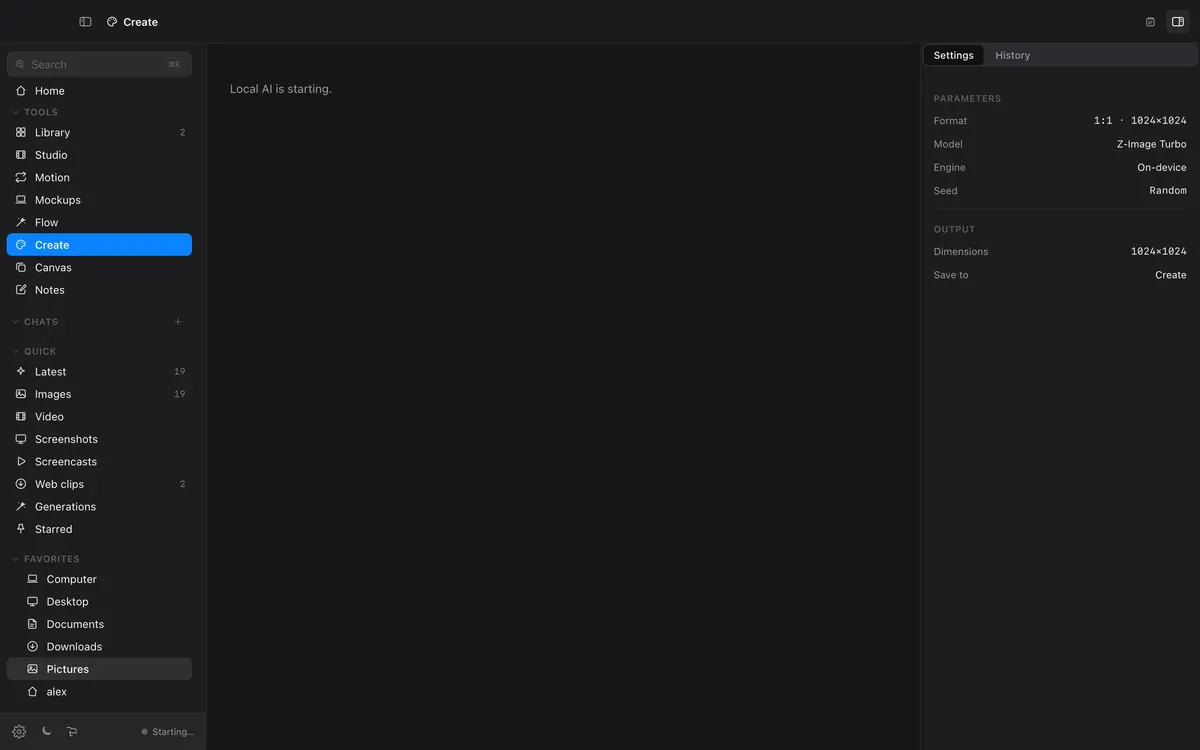
  • Image-to-image keeps your reference. In Create, a low variation setting gave you near-pure grain instead of your picture, because the setting was applied backwards. Low variation now keeps you close to the reference, and a close-to-reference run gets about six real steps instead of one or two.
  • Takes open with a picture. Opening a take in Studio could give you black video with sound until you switched between GPU and CPU rendering. The first frame now shows when the take opens.

StudioCanvas & CreateLibrary & Lenses
0.62.3Jul 13Screen-Studio-class recording — and a Mac that stays responsive
  • Studio, rebuilt. 36 curated backgrounds in six categories, a 3×3 camera grid with roundness and aspect shapes, cursor idle controls, advanced motion blur, and captions you can edit and retime on a timeline track.
  • Webcam in your recordings. Turn on the camera bubble with a single click — proper macOS permission, done right.
  • Your canvas is safe. Fixed two bugs that could blank a board: one dropped placements when a folder was briefly offline, one opened boards empty.
  • Calmer, clearer everywhere. An in-app confirm sheet instead of system alerts, note tabs to keep several notes open at once, a tidier five-tab inspector with a real visual-similarity finder, and a clearer reference picker in Create.
  • Generation that frees its memory. On-device image models now unload and drop their cache after a render, so a busy session no longer eats your RAM.
0.62.2Jul 13Note tabs, and an inspector cut from nine tabs to five
  • Notes open in tabs. Opening a note now adds a tab above the page instead of replacing the one you had, and + opens a searchable picker for another. Close the active tab and you land on its neighbour; close the last one and you are back at the grid.
  • Nine inspector tabs became five. Info now carries the colour palette, a new AI tab stacks Prompt, OCR and Design in one scroll, and Similar works on the file in front of you: 18 visually similar images from your library, one click to select. For an image the tabs are Info, AI, Similar, Ask and Notes.
  • Two failures fixed. A Canvas board could open as an empty grey pane with its images just out of view; it now frames them once they load, and later refreshes leave your pan and zoom alone. When the Mac is briefly short of resources, dictation now retries once and then asks you in plain words to try again, instead of showing a raw system error.
0.62.1Jul 10An offline folder no longer takes your canvas with it
  • Canvas images stop vanishing. If a library folder was unreachable at launch, for example Dropbox or iCloud not yet mounted after login or an external drive unplugged, the clean-up of missing files removed those images from your boards for good, and just browsing a folder could do the same. Files placed on a canvas are no longer removed automatically, files whose whole folder is gone wait until it comes back, and if more than 10% of your library and more than 25 files look missing at launch, nothing is removed at all.
  • Deleting asks first, inside the app. Moving files to the Trash and deleting a collection, a board or a chat now ask in a sheet that matches the app instead of a system alert; a chat used to go on a single click of the ×. Cancel in the viewer keeps you on the file you were on, and focus returns to the grid, so you can keep culling with Delete, Enter and the arrow keys.
  • Camera and captions in Studio. Turning on the webcam, or pressing Enable in Settings → Permissions, used to be refused without a prompt, and OY.Surf never appeared under Privacy & Security → Camera; macOS now asks. Captions fade in and out the same way in preview and export, sit on their own timeline lane where you drag one to move it or drag its edges to retime it, can be edited, added at the playhead or deleted from the list, and known phrases the transcriber invents over silence are now filtered in German, French, Italian, Spanish, Chinese and Japanese too.
0.61.0
Notarized
263 MB GitHub ↗

Recording keeps going when you leave Studio

New

  • Recording survives leaving Studio. Go to the library, a note or anywhere else mid-take and the capture keeps running, with a small always-on-top pill showing the red dot, the elapsed time and Stop. The pill never appears in the footage, and reopening Studio picks up the live take with the true elapsed time.
  • The webcam asks first. Turning on Camera in Studio now requests access, and if access was denied the toggle says so instead of silently recording nothing. The permissions panel in Settings has a Camera row as well.

Better

  • Media controls that match the app. Video and audio in the viewer get their own play/pause, scrubber, time, mute and speed, and the floating toolbar no longer covers the timeline. PDFs fill the full width without the dark toolbar on top, and a fullscreen button sits next to the close button.
  • Quieter scrollbars. They are 9px, tinted to the theme and hidden until your pointer is over the list, replacing the chunky white bars in the sidebar, the library and notes. Folder chips are now pills with a round cover.

Fixed

  • Back to the canvas, not the folder. A file opened from a board now opens on top of it, the arrows browse the board's items, and closing returns you to the board. Escape closes the viewer, not the canvas.
  • Chats stay apart. Switching chats mid-answer no longer shows the other chat's typing or tool line, and a finished reply always lands in the chat that asked for it. On-device, asking for your latest notes now returns the actual most recent ones with excerpts, and the model no longer claims it cannot open local files.

StudioNotch & ClipboardLibrary & LensesCanvas & CreateAsk & Agents

0.60.0
Notarized
263 MB GitHub ↗

A library you can just ask

  • Chat over your whole library. An on-device agent that searches, reads and answers about your files — with retrieval over your notes, OCR text and transcripts.
  • Views that remember. Per-folder filter and layout settings that stick.
  • A permanent Home. A start page that greets you with what you were working on.
  • Native scrollbars. Dark macOS overlay scrollbars that appear only while you scroll.

Ask & AgentsLibrary & Lenses
0.59.0
Notarized
263 MB GitHub ↗

Every folder opens the way you left it

  • View settings per folder. Display mode, sort order and thumbnail size used to be shared by every folder. Now each location keeps its own: a folder, a quick folder, a smart folder, a collection, Home, and each project.
  • The type filter stays put. Your choice of Everything, Images, Videos, PDFs or Notes is also remembered for each location. It used to reset every time you switched folders.
  • Still there after a restart. Quit and relaunch, and each location comes back with its own view and filter.

Library & Lenses
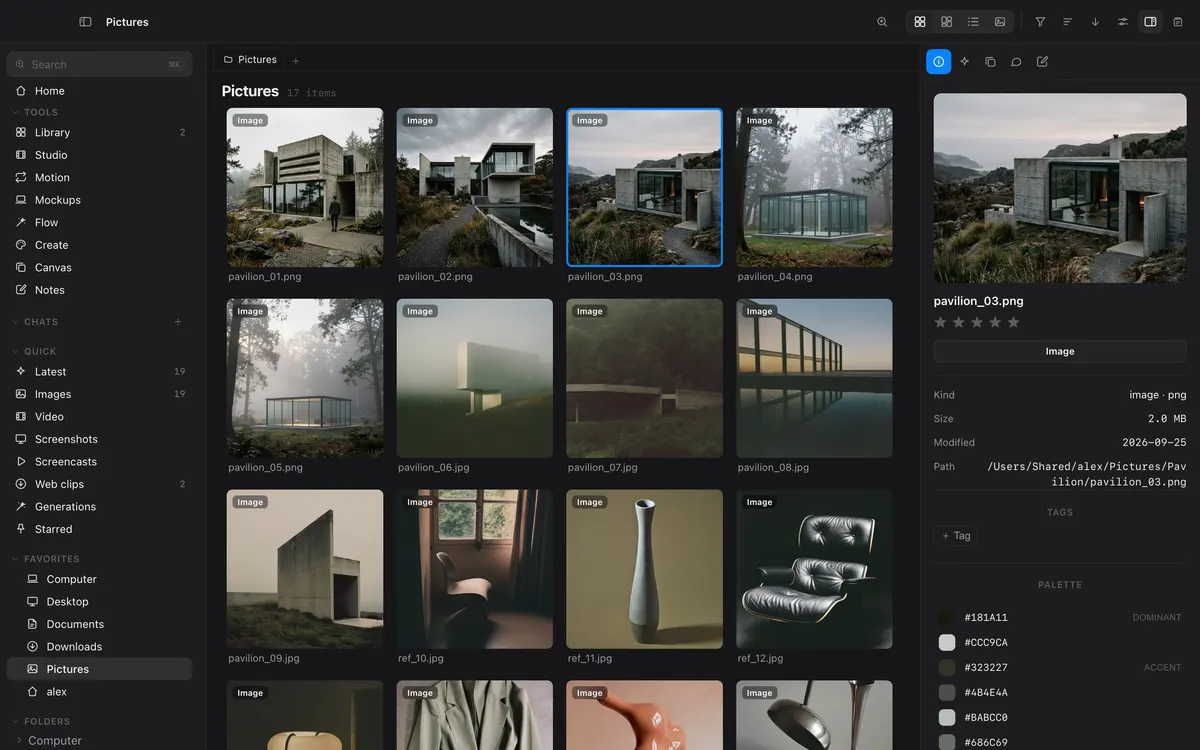
Library, browsing a folder, in the current app
FIG · Library, browsing a folder · the current app
0.58.0
Notarized
263 MB GitHub ↗

One toolbar for every image you select on the canvas

  • No more stacked toolbars. When you select several images on the canvas, each one no longer shows its own floating toolbar. One shared bar appears for the whole selection.
  • Every action applies to the whole selection. Align, Distribute, Smart resize, Tools, Send to Figma and remove all act on every selected image at once.
  • Same bar for one image or many. With one image selected, Caption, Vary, Open and Reveal are still there. Align and Distribute appear once you select more than one.

Canvas & Create

A canvas board, in the current app
FIG · A canvas board · the current app
0.57.0
Notarized
263 MB GitHub ↗

AI that respects your memory

  • Models that step aside. On-device models unload when idle and reload on demand, so AI never pins gigabytes in the background.
  • Dictation always ready. Flow keeps its own always-on engine warm — your first word is never clipped.
  • See what's loaded. A memory panel showing exactly what's in RAM.

Flow & Notes

0.56.0
Notarized
263 MB GitHub ↗

Studio setup in one card, and a menu for every canvas

  • Studio setup, in one card. The floating pill buttons you saw before recording are now one grouped settings card. Each row has its label on the left, its control on the right and a hairline between rows. Hide desktop, Camera and Microphone are now on/off switches instead of full-width buttons.
  • A real menu for every canvas. Right-click a canvas in the sidebar or its card in the grid to get Open, Rename, Duplicate and Delete. Before, you only got a delete confirmation. Rename happens in place, and Escape backs out of the menu or the rename without closing the canvas you have open.
  • Duplicate a whole canvas. Duplicate copies everything on a canvas into a new one: items, connections, notes and ink. Connections attached to notes come across too.
  • Drop files onto a canvas without opening it. Drag files from your Mac onto a canvas in the left sidebar and they are added to that canvas.

StudioCanvas & Create

0.55.0
Notarized
263 MB GitHub ↗

Right-click any image to cut it out or upscale it

  • Photo tools, library-wide. Right-click any single image in your library and the photo tools that used to work only on the canvas are there: Remove Background, Remove Background (HQ), 4x upscale, Portrait Blur and Beautify.
  • Runs as a task. Each edit goes to the tasks centre, which shows a spinner while it works and a thumbnail of the result when it is done. Click the thumbnail to open the result.
  • Saved like a generation. The result is saved as a new image in your Create folder, next to your generations.

Library & Lenses
0.54.0
Notarized
263 MB GitHub ↗

Depth-aware portrait blur, on your Mac

  • Portrait Blur. A new image action works out how far away each part of the picture is, keeps the near subject sharp and blurs the background behind it. It runs on your Mac. The first time you use it, it downloads a model of about 50 MB. In testing, the blur itself took about 11 seconds.
  • Slow edits show they are working. HQ background removal, AI upscaling and Portrait Blur take 10 to 16 seconds or more, and the canvas used to look frozen while they ran. Now every image edit on the canvas shows a banner with a spinner until it finishes or fails.
  • A heads-up before the first download. For HQ background removal and AI upscaling, the banner names the action and tells you the first run downloads a model, so a long first wait does not look like a hang.

Canvas & Create

0.53.0
Notarized
263 MB GitHub ↗

An on-device AI studio

  • Cut out and upscale, locally. High-quality background removal and Real-ESRGAN upscaling, entirely on your Mac.
  • Image actions, queued. Run edits from the right-click menu through a generation queue that never blocks you.
  • A richer Create & canvas. Custom canvas backgrounds and a recorder that paints its first frame on the GPU.

Canvas & CreateStudio

0.52.0
Notarized
263 MB GitHub ↗

Background removal that keeps the hair

  • Cutouts that keep the hair. A new high-quality background removal, built on the open BiRefNet model, handles hair and complex edges better than the instant cutout. You get a transparent image at the original size.
  • It runs on your Mac. The model is about 1 GB. It downloads the first time you use it and is listed in Settings under AI. In a test run, one cutout took about 16 seconds.
  • Two ways in. Pick it from the Tools menu, or type /remove-bg-hq. The instant cutout is still there for when speed matters more than edges.

Canvas & Create

0.51.0
Notarized
263 MB GitHub ↗

Fifteen fixes, two of them for work that went missing

  • Canvas resizes stay resized. If you resized an image or a note on a Canvas board, it went back to its old size when the board reloaded, because the saved width lagged behind the one on screen. Your resizes now survive a reload.
  • A failed note save tells you. If a note could not be written because its folder had moved, the disk was full or the volume was read-only, your edits were dropped without any warning. Now a banner tells you the save failed, and the note keeps your changes so the save can run again.
  • A stuck model no longer stalls generation. A hung local model process used to freeze the generation queue. Status checks now time out and the process restarts on its own, and an old process can no longer knock over the one that replaced it. If a result can't be placed on a board, it is no longer reported as a failed generation.
  • The library keeps up. Shift-selecting in the gallery could crash it, and that no longer happens. New thumbnails and changes on disk now reach every library view, not just one. A removed file no longer lingers in the Create fullscreen viewer.
  • No phantom connections. When you removed something from a board, its connections could stay behind and come back later as phantom links. Now they are deleted along with it.
  • Studio takes stop overwriting each other. A late stop or error from an earlier recording could overwrite a newer take, and two takes started in the same second could collide. Studio no longer records the wrong window or one that has already closed, and reloading a take no longer leaks a video decoder each time.

Canvas & CreateLibrary & LensesStudio

0.50.0
Notarized
263 MB GitHub ↗

Pick the window you want to record by seeing it

  • A picker you can see. In Studio, choosing a window to record used to mean picking its name from a plain list. Now every window is a tile in a grid, showing a thumbnail of what is in it, the app name and the window title. Click a tile to select it.
  • The app icon on every tile. Each thumbnail has its app's icon in the corner, so you can see which app a window belongs to at a glance.
  • A tile even without a preview. If macOS won't draw a thumbnail for a window, its tile shows just the app icon. Recording itself works exactly as before.

Studio

0.49.0
Notarized
263 MB GitHub ↗

Studio checks permission before you press Record

  • Permission before you press Record. If Screen Recording access is off, a banner at the top of the record screen tells you. The Record button stays disabled and reads "Permission required" until access is granted. The duplicate grant button at the bottom is gone.
  • More detail in the source picker. The window option shows how many windows you can choose from, and a selected area shows which display it is on and its coordinates. The camera and microphone toggles name the device in use.
  • A transport bar that uses its width. The playback controls sit in two groups with a divider between them, spread across the bar instead of bunched on the left. A thin line underneath shows how far you have scrubbed, and the time readout is larger.
  • An inspector that holds its width. The inspector keeps a minimum width, so sliders and segmented controls no longer get squeezed in a narrow window. The timeline ruler has finer tick marks and cleaner labels.

Studio

0.48.0
Notarized
263 MB GitHub ↗

Zoom and scroll the Studio timeline

  • Zoom the timeline. Use the − / Fit / + control, ⌘-scroll, or a trackpad pinch. Zoom is anchored to your cursor, so the moment you were looking at stays under it, and it never zooms out past the full take.
  • Reach any point of a long take. A long recording is no longer squeezed into an unreadable sliver. Scroll sideways to get anywhere in it, and a plain vertical scroll pans the timeline too.
  • The playhead stays in view. On a zoomed timeline it follows playback on its own, and holds off for about 1.2 seconds after you scroll or zoom by hand.
  • Easier to read at a glance. The timeline now shows filmstrip frames, and its lanes are taller, 28 px instead of 24, with more space between them.

Studio

0.47.0
Notarized
263 MB GitHub ↗

Cut out, convert and compress, right on the board

  • Four image actions, on your Mac. Remove a background, convert between PNG, JPG and WebP, compress, or set an image in a matte with a rounded frame and a soft shadow. All four run on your machine. Start them as skills or from the Canvas Tools menu, and the result drops onto the board.
  • A Canvas background you choose. Use plain, dots, grid or crosses, and set your own color and spacing from a panel in the top-right corner. Until you pick a color, the background follows the app's light or dark theme.
  • Start as many generations as you like. Firing off several at once used to stop at "a generation is already running". Now they queue without a limit, and a strip along the top shows how far along they are. Create runs through the same queue.
  • Failures say so. When Generate in Create or an edit from the Tools menu fails, you now see the error.

Canvas & Create

0.46.0
Notarized
263 MB GitHub ↗

Documents get real cards, and the pen gets colour

  • A pen with a palette. While the Pen tool is active, a row of colour swatches and three sizes (S, M and L) appear. Each new stroke keeps its colour and width.
  • An eraser for whole strokes. Scrub over a stroke and it is deleted.
  • Documents show up as documents. .docx, .doc, .rtf, .odt, .pages, .key, .numbers, .xls, .xlsx, .ppt and .pptx files now get a labelled DOC, SHEET or SLIDES card in the library and on the canvas. They no longer show as broken tiles.
  • Text files you can read. Plain .txt and .csv files now show as text cards.
  • Info for fonts and audio. The Info lens now shows duration, format and bitrate for audio files, and the format for fonts. Neither one offers image-only lenses any more.

Canvas & CreateLibrary & Lenses
0.45.0
Notarized
263 MB GitHub ↗

Record one window, or just the area you drag

New

  • Record a window or an area. The recorder now has a source picker: Screen, Window or Area. Pick Window to capture that one window on its own. Pick Area to drag a rectangle over the part of the screen you want. You can also hide desktop icons while you record.
  • Permissions in one place. Onboarding now has a step for Screen Recording, Microphone and Accessibility, and it shows the status of each one as you grant it. The same panel is under Settings → Permissions.

Fixed

  • Rating hotkeys work in every view. This release fixes 29 defects found in a review of the whole app. Rating and flag hotkeys in the grid did nothing in the Library, Quick and Smart views. They now act on the files you see there. Each image you paste or import now gets its own filename.
  • Voice notes stay with their file. If you change the selection while a note is being transcribed, the text still goes to the file you recorded it on.
  • Studio edits do what you asked. The clip context menu acts on the clip you clicked. Restoring one manual cut no longer brings back the cuts merged with it. Cancelling an export stops it at any stage.

StudioLibrary & Lenses
0.45.9Jul 5A pen for the canvas
  • Draw on the board. A new Pen tool, on the dock or under P, draws freehand strokes on the canvas. With a stylus, your strokes pick up pen pressure.
  • Strokes stay put. They stay pinned to the board when you pan and zoom. They save with the board, come back when you reopen it and appear in the PNG export.
  • Take back a line. In pen mode, Backspace, Delete or ⌘Z removes the last stroke, and Clear drawing removes all of them. The Select and Hand tools work as before.
0.45.8Jul 5Canvas opens on all your boards
  • Every board in one grid. Canvas (⌘5) now opens on an overview of all your canvases, with each one's name and item count and a card for starting a new one. It no longer drops you straight into your first board or an auto-created one.
  • A way back. When a board is open, the title bar shows "Boards / name". Click Boards to return to the overview.
0.45.7Jul 5Studio's editor, redrawn panel by panel
  • Calmer panels and record screen. Side panels no longer repeat their title in bold. Sliders have a visible track and a 14px handle, the selected option in a segmented control no longer turns bold, and thin lines separate the sections. On the record screen, Screen · Window · Area is one segmented control, and capture toggles are tinted when they are on.
  • Animation you can pick by eye. Screen animation (Focused, Smooth) and cursor animation (Smooth, Medium, Rapid, None) are now raised tiles, each with an icon, instead of a row of flat pills. The settings behind them have not changed.
  • A clearer timeline. It runs edge to edge under a plain monospaced ruler. Clips sit in a taller amber lane, zoom keyframes are blue blocks, and the playhead is a slim white line with a round knob. Only the look changed: recording and editing work exactly as before.
0.45.6Jul 5Audio and font files in your library
  • Two new kinds of file. Your library now picks up audio (mp3, wav, m4a, aac, flac, ogg, opus, aiff) and fonts (ttf, otf, woff, woff2, ttc). They are indexed and thumbnailed like everything else.
  • Thumbnails you can read. An audio file shows its waveform and a font shows an "Aa" specimen. If either one can't be drawn, you get a labelled card instead.
  • Play audio, read a font. Audio plays in the viewer next to its waveform. A font opens as a live specimen sheet with its alphabet, glyphs and a range of sizes.
0.45.5Jul 5Previews that load, and a canvas that takes your files
  • Previews show up. An imported PNG on the canvas uses the original file until its thumbnail is ready, so it no longer says "Image unavailable". MP4 videos now get a poster frame, and PDF thumbnails that failed before are retried, with a labelled card instead of a bare badge if one still fails. In the fullscreen viewer, video plays with controls, and a PDF that renders blank offers Open in Preview or Reveal in Finder.
  • Drop files onto the canvas. You can drag Markdown, PDF, doc and video files onto a canvas to import them and place them there. Press T to add a text note, and move a note by its grip strip. The top toolbar buttons that repeated the bottom dock are gone.
  • Notes, search, tabs and Studio. A note now opens as a rendered preview, and a click or Enter starts editing, so paging through notes no longer drops you into the editor. Library search now covers your whole library. You can drag the top tabs to reorder them, and the Studio home screen scrolls so you can reach your recent takes.
0.45.4Jul 5The Clipper captures the whole page
  • The whole page in one image. The Clipper now saves a full-page screenshot as one PNG in Downloads/OY.Surf, in a folder for each site. It scrolls through the page first so scroll-in animations play and lazy images load, then captures it in a single pass, so sticky menus show once and there are no seams. Pages cap at about 30,000 pixels tall, and the capture needs one new browser permission; where that isn't available, for example with DevTools open or in Safari, the Clipper scrolls and stitches the page instead.
  • Canvas follows the trackpad. Swipe with two fingers to pan and pinch to zoom. A plain scroll wheel now pans too, and ⌘-scroll still zooms.
  • Trashed images leave Create at once. When you move a generation to the Trash, its tile disappears from the recent grid right away. Before, it stayed there until you reopened Create.
0.45.3Jul 517 fixes to the grid, menus and scrolling
  • The grid keeps up with you. Single-letter shortcuts such as f, p, x and 1–5 no longer also type into the search box, and ⌘F and ⌘1–6 work as before. New files appear in the Library, quick folders and smart filters as they arrive, deleted files leave the grid at once, and the viewer closes if you delete the file it shows. After you switch quick folder, filter, collection or project, Space and the slideshow no longer open a file from the previous list.
  • Menus close and act on the right file. The right-click menu acts on the file you clicked, and its rating, like Pin in the selection bar, reflects the whole selection. Canvas node menus close on Escape or an outside click, and Studio presets and view options close on Escape. On a board, Escape closes an open menu or the Ask bar before it leaves the board.
  • One scrollbar where you expect one. Wide tables in chat and notes scroll sideways instead of spilling out, a note has one scrollbar instead of two, and Studio's captions list scrolls with the rest of its panel. The right panel returns to the top when you switch file or lens.
0.45.2Jul 5Drag to select on Canvas, Delete to trash
  • Drag to select on Canvas. With the Select tool, a left-drag on empty canvas now draws a box and selects every node inside it. Panning moves to the middle or right mouse button. The Hand tool still pans on a left-drag.
  • Every selected tile shows it. A selected note, PDF or placeholder tile showed no selection ring. Only images did. The ring now shows on every tile type.
  • Delete sends files to the Trash. In the grid, Delete or Backspace moves the selection to the Trash, but not while you are renaming something. In the fullscreen viewer, it moves the current file to the Trash and steps to the next one, or closes after the last.
0.45.1Jul 5Select everything, not just what is on screen
  • Select all, really all. There was no select-all, and a selection box only caught the tiles drawn on screen, so a folder of 5,000 files could show 8 selected. Press ⌘A to select every file in the current view, including the ones scrolled off screen. It works in Library and Create.
  • No white bar in Create. An extra white scrollbar stayed visible in Create at all times, unlike anywhere else in the app. It is gone. The grid scrolls on its own, as in Library, and your wheel and trackpad scroll as before.
0.44.0
Notarized
263 MB GitHub ↗

A recorder that rivals the paid ones

  • A real clip timeline. Draggable zoom blocks, editing presets (Blank / Dark / …), and settings you set before you record.
  • Export how you need it. GIF export and pitch-preserving speed changes.
  • Review in full screen. Open any generation from the Create grid in the fullscreen viewer.

StudioCanvas & Create

0.43.0
Notarized
263 MB GitHub ↗

Open your generations in the fullscreen viewer

  • Generations open full screen. Double-click a tile in the Create grid, or press Space, and it opens in the same fullscreen viewer as the library. Before, a double-click only set it as a reference.
  • The whole viewer comes with it. Lenses, previous and next through your generations, and rating all work there. Esc takes you back to Create.
  • Reference moves to the (i) button. The (i) button on a tile still sets it as a reference, one click away.
Create, in the current app
FIG · Create · the current app
0.42.0
Notarized
263 MB GitHub ↗

Set up your camera, mic and countdown before you record

  • Pick your camera and mic. The idle Studio screen now has a setup panel where you turn the camera and microphone on or off and choose the device for each. The recording uses the device you picked. Device names appear after you first grant access, and the list updates when you plug in or unplug a device.
  • A countdown before capture. Choose Off, 3s or 5s. A full-screen 3-2-1 plays before recording starts, and your choice is remembered for the next take.
  • System audio, stated plainly. Studio already records the sound from your Mac, and the setup panel now says so. To drop it from a single take, mute it in the editor.

Studio

0.41.0
Notarized
263 MB GitHub ↗

Save the look of a recording and reuse it

  • The whole look in one click. A Presets menu in the Studio editor applies background, padding, corner radius, shadow, background blur, motion blur, cursor size and aspect ratio to the current take at once. Audio, webcam, captions, crop and zooms stay as they were.
  • Four to start from. Blank, Clean, Dark and Social 9:16. The last one also switches the frame to vertical.
  • Presets of your own. Name the look you have now and save it. Your own presets can be renamed, updated to match your current settings or removed. A preset changes only when you update it.
  • A default for new recordings. Mark any preset as the default, built-in or your own, and a new take you have not edited yet opens with that look already applied.

Studio

0.40.0
Notarized
263 MB GitHub ↗

Studio gets a clip timeline

  • Clips, not a filmstrip. The video lane in Studio is now a row of clips you can select. Each one shows its length and speed, like 11s · 1×, and a right-click gives you Set speed, Split at playhead, Merge with next or previous, and Remove.
  • Split where you want. Press C to split at the playhead, or turn on the scissors in the transport and click the timeline where you want the cut. A dashed line follows your cursor to show where it will land.
  • Retime one clip at a time. Set speed changes only the clip you picked, so you can speed up the slow part and leave the rest at 1×.
  • Removing is reversible. Backspace or X removes the selected clip and leaves a seam marker where it was. Click the marker to bring the clip back. Splits are saved with the project, and undo and redo cover them.

Studio

0.39.0
Notarized
263 MB GitHub ↗

Dictation cuts ahead of image generation

  • Dictation goes first. If you dictate while Create is generating an image on your Mac, the generation pauses between steps until your words are transcribed, then carries on.
  • Reference images from Documents or Desktop. Dragging in an image from Documents, Desktop or Downloads as a reference used to fail with "Operation not permitted", even though the app could open the file. The image is now copied somewhere the generator can read before generation starts.
  • Timeline shortcuts in Studio. Delete, Backspace or X now removes the selected zoom or speed block instead of only the marked range; Z adds a zoom, S splits at the playhead, and every button's tooltip shows its shortcut. The buttons are quieter too, with the accent colour kept for toggles that are on.
  • Controls on full-screen pages. The note page covers the title bar, so it now has its own Back, sidebar and inspector buttons, and its MD, Focus and Typewriter tabs no longer overlap. Studio's bar gets a sidebar toggle too.
  • Your tasks, where you are. The tasks menu now sits in the title bar of Create, Flow and Canvas, so a generation you started stays visible without leaving the mode you are in.

Flow & NotesStudioCanvas & Create

0.38.0
Notarized
263 MB GitHub ↗

Faster, steadier, more shareable

  • GPU compositor. Studio composites on the GPU with a smoother synthetic cursor.
  • Streaming export. WebCodecs export without seeking, plus a GIF pipeline.
  • No more hangs. Sidecar timeouts and self-healing dictation keep the app snappy.

StudioFlow & Notes

0.38.2Jul 4A stuck model can no longer freeze the app
  • No more endless “Transcribing…”. If the on-device model stops answering, the request now fails after a set time instead of freezing the interface. Every model request you start has a time limit, from one minute to ten depending on the job.
  • Dictation restarts its own engine. When a dictation times out, Flow spends up to 5 seconds checking whether the on-device engine still responds. If it does not, Flow starts a fresh one and tells you to try again, so you are not left waiting on a process that will never answer.
0.38.1Jul 4Dictation no longer hangs after an update or crash
  • No more endless Transcribing. After a crash or an update, the old copy of the background process that runs dictation could keep running. The next launch reused it as it was, so the process could be days older than the app you had just installed. Dictation then stayed on Transcribing forever. On launch, the app now checks that the running process is from the same build and replaces it if it is not.
  • A stalled process gets restarted. If the app reuses a process it did not start itself, it now keeps checking on it. After two missed checks, it starts a fresh one.
0.37.0
Notarized
263 MB GitHub ↗

Folder titles, list columns, a viewer that stays open

New

  • Where you are, and how much. The folder you are in now sits above the grid as a title with its item count. It does not show in file tabs or chats.
  • Columns in list view. The list view has a header that stays put as you scroll: Name, Kind, Size, Dimensions, Modified, lined up with the rows beneath it.

Better

  • The AI chip goes somewhere. Click the AI status in the sidebar and Settings opens on the AI models tab.
  • One pass for duplicate checks. When the Duplicates lens and an agent look for duplicates at the same time, they share one pass over your images instead of each reading every image.

Fixed

  • The viewer stays open. Removing files elsewhere in the library, for example an agent cleaning up a folder, used to close the fullscreen viewer. It now closes only if the file you are looking at is the one removed.
  • No ghost tiles on boards. When a file is removed, an open board drops it and its connections right away instead of leaving a tile behind for a file that is gone.

Library & LensesCanvas & Create

0.36.0
Notarized
263 MB GitHub ↗

Sped-up clips keep their pitch on export

  • Sped-up audio keeps its pitch. Speed up part of a Studio recording and the exported file now sounds like the preview: voices and music keep their pitch instead of rising with the speed. If pitch correction fails to load once, the next export tries again instead of leaving it off for the rest of the session.
  • Clean starts on sped-up segments. Each sped-up segment starts at full volume, with no soft fade-in where the speed changes. Segments at normal speed export exactly as before.
  • Cancel stops every export. Cancel now also works on the backup exporter, where it did nothing, and during warm-up it responds right away instead of after several seconds. When you cancel, the Export button comes back and no file is written.
  • Fewer exports sent to the backup exporter. Some recordings were moved off the main exporter because their first frame seemed to be missing. They now export on the main path.

Studio

0.35.0
Notarized
263 MB GitHub ↗

Agentic MCP + polished exports

  • Your library, as tools. Four agent tools over MCP and a .mcpb desktop extension that can open boards live.
  • Cleaner Studio export. Export with pitch preserved and a cancel button that actually cancels.

Ask & AgentsStudio

0.34.0
Notarized
263 MB GitHub ↗

Studio exports ten times faster

  • Export reads your take once. Studio now reads the recording straight through, start to finish, with no seeking and no warm-up. A 534-frame take exports in 3.9 seconds, down from about 40.
  • The preview stays yours. Export renders separately from the editor, so the preview is left untouched while it runs.
  • Trims and cuts keep the speed. Trimmed and cut takes export the fast way too: a trimmed 241-frame export takes 2.1 seconds. A file that can't be read straight through still exports the slower way.

Studio

0.33.0
Notarized
262 MB GitHub ↗

One way of moving, and a calmer Studio

Better

  • One way of moving. Popovers, sheets and pages each get one consistent entrance, toggles take 220 ms, and every transition in the app runs on shared timing. If you have Reduce Motion switched on in macOS, the app follows it.
  • A quieter Studio editor. Flat chrome with hairline splits, a tinted rail, styled sliders and one 16px rhythm through the editor. Play, Export and the rest follow your system accent colour instead of a fixed blue of their own.
  • Canvas gets out of the way. Handles show only when you hover, and a selection sits flush against the item instead of floating around it.
  • Tidier library and inspector. Tiles get a clean selection ring, Info reads in two columns, the inspector opens with a 4:3 preview and 30px lens tabs. Home, Flow and Settings sit on card surfaces, and the empty status bar row is gone.

Fixed

  • Esc closes the command palette. Wherever focus happens to be.

StudioCanvas & CreateLibrary & Lenses
0.32.0
Notarized
262 MB GitHub ↗

Studio exports MP4 on the hardware encoder

  • Hardware MP4 export. Studio now renders your edit frame by frame, encodes H.264 on the Mac's hardware video encoder and writes AAC audio into the same MP4. If that path is unavailable, it falls back to the previous exporter instead of failing.
  • Sound follows your edit. Audio is mixed through your cuts and speed changes before it is encoded, so a voice-over stays in sync from the first cut to the last.
  • Export in the background. Switch to another app while an export runs and it keeps going. The Studio window does not need to stay in front.
  • Large recordings keep their sound. Audio is read from the recording separately, so a recording over 2 GiB exports with its sound.
  • The editor holds still while it works. Keys, playback and scrubbing are locked during export so they cannot disturb the render, and the preview goes back to where you left it. If an export fails, the message tells you whether encoding or saving the file went wrong.

Studio

0.31.0
Notarized
262 MB GitHub ↗

Paste-anywhere notes, GPU-first

  • Paste images into notes. Drop a screenshot straight into a note and it's saved and linked.
  • Smoother motion. Catmull-Rom cursor smoothing and the GPU compositor on by default.

Flow & NotesStudio

0.30.0
Notarized
262 MB GitHub ↗

Studio moves to the GPU, and learns to cut

  • Cut by hand. Mark a range with I and O, then cut it out, keep only that range, or restore it. The preview and the export both follow the cut.
  • The GPU is the default renderer. Studio now composites on the GPU, and a GPU/CPU switch in the header remembers your choice. It draws everything the CPU path does, including background images, spotlight, image cursors, text annotations and source crop.
  • GPU output matches the frame. Zoom stays inside the padded frame, the shadow and plate sit on the frame, and gradients, vignette and spotlight render properly. Webcam and captions stack in the right order, graphics memory is released instead of leaking, and if the GPU cannot start, Studio falls back to the CPU.
  • Missing images stay out of the way. When an image in Compare, Lenses, Create or Studio can no longer load, for example because the file moved, it is hidden instead of showing a broken-image icon.
  • Keyboard and screen reader access. Compare panes and Studio takes now respond to Enter and Space, and screen readers announce them as buttons.

StudioLibrary & Lenses
0.29.0
Notarized
262 MB GitHub ↗

Focus and typewriter modes in notes, diagrams in Ask

  • Focus mode. Switch on Focus in a note and every paragraph except the one your cursor is in dims. The paragraph you are writing stays lit and the rest of the note fades back.
  • Typewriter scrolling. Switch on Typewriter and the line you are typing stays centered in the editor instead of creeping toward the bottom edge. Both switches sit in the note's header, next to MD, and you can use either one or both.
  • Diagrams render as diagrams. A Mermaid code block in an Ask reply or in a file's notes now shows as a drawn diagram, not raw text. If the diagram has an error, you see its source instead of an empty space. The diagram engine loads only when the first diagram appears.

Ask & Agents

0.28.0
Notarized
228 MB GitHub ↗

Notes export to Markdown, HTML and PDF

New

  • Export a note. The Export button next to Recipes saves the note as Markdown, HTML or PDF. HTML and PDF come out as a plain, readable page with styled headings, tables, code blocks and images.
  • Math renders. LaTeX between single dollar signs shows inline, and between double dollar signs as a block, in the notes preview and in chat replies.

Fixed

  • No more broken tiles. If a thumbnail fails to load, the tile shows its file-type badge instead of a broken image.
  • Long names stay contained. File names are clipped to three lines in the inspector and to one line in the folder tree, so they no longer push the layout around.

Ask & AgentsLibrary & Lenses

0.27.0
Notarized
222 MB GitHub ↗

The Dock icon is there every time you launch

  • No more invisible launches. Starting from a login item, or opening the app again while it was already running, could leave it with only its menu bar icon and nothing in the Dock. The Dock icon now comes up first, before the window and the menu bar icon, so it is there in those cases too.
0.26.0
Notarized
222 MB GitHub ↗

Markdown in chat replies and a full file grid in Create

New

  • Replies render as Markdown. Headings, lists, code blocks, tables and links in a chat answer now show formatted, not as plain text.
  • Copy or pin a message. Hover any message for two buttons: copy its text, or pin it. A pinned message keeps an accent edge and is still pinned when you come back to the chat.
  • Create gets the Library's file manager. Every image you generated or edited in Create now shows in a grid that works like the Library's, not just the last 12, with marquee selection, the same right-click menu and rename in place. Rate with 1–5, favorite with F, pin with P, reject with X, and double-click an image to use it as the reference.

Fixed

  • Finished generations show up at once. The tasks menu shows the actual image the moment a generation completes, instead of a broken thumbnail while its preview is still being made.
  • Search and note titles fit. The search field and long note titles no longer get cut off.

Ask & AgentsLibrary & Lenses

JUNE 202626 RELEASES

0.25.0
Notarized
222 MB GitHub ↗

Post-Chat polish

  • Select like a pro. Rubber-band multi-select and a floating action bar across the grid.
  • No more keychain nag. Removed the password prompt that appeared on every update.
  • Create gets the full manager. The same Gallery file manager you use in the Library, right inside Create.

Library & LensesCanvas & Create

0.24.0
Notarized
222 MB GitHub ↗

Chat, a real canvas, a library that follows your work

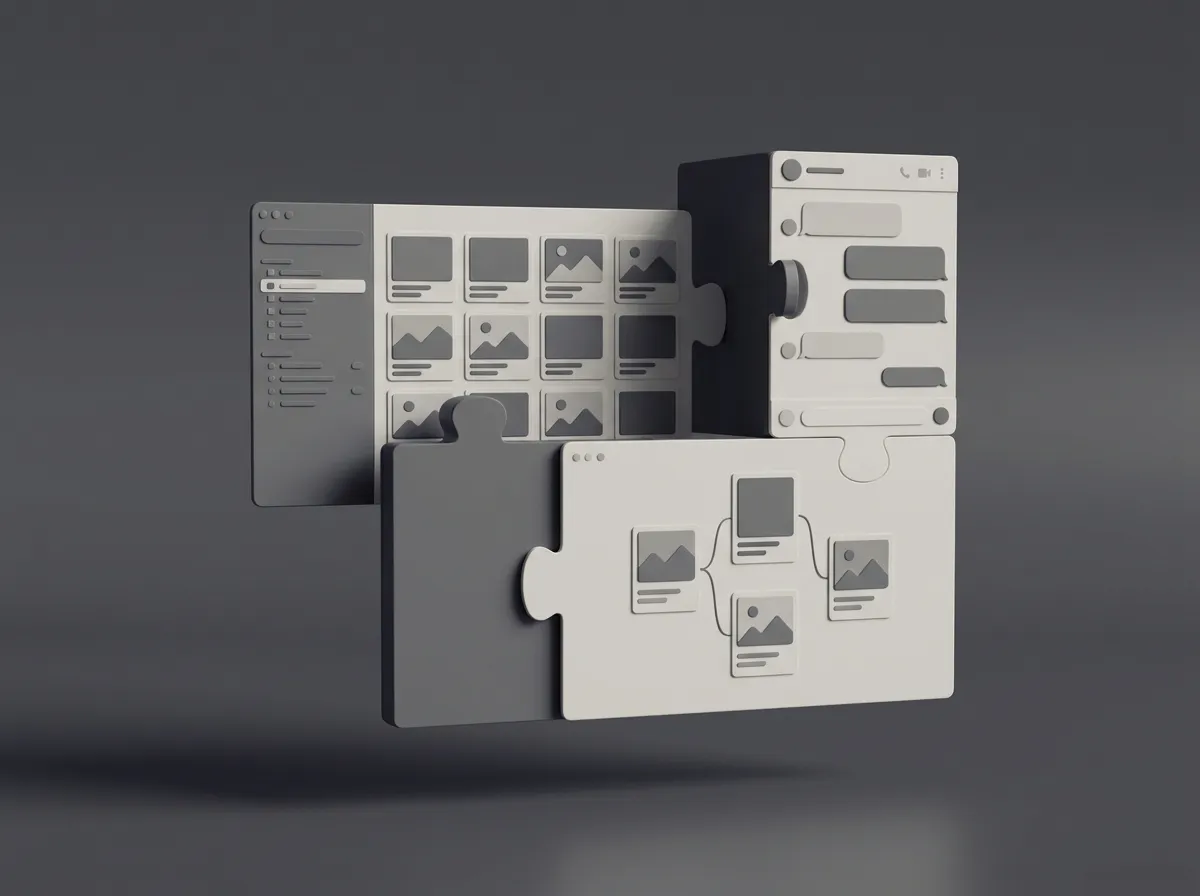
  • Local chat, on-device. A private assistant with saved sessions in a collapsible Chats section — nothing leaves your Mac.
  • A real moodboard canvas. Resize and restack cards, connect them, export the whole board as a PNG, and undo/redo anything.
  • A library that follows your work. "In work" surfaces what you actually use across your whole Mac — ranked by real usage, junk filtered, and auto-grouped into Projects.
  • Sharper Create & Studio. A real parameters + History inspector in Create; the Studio recorder now composites on the GPU.
  • Calmer dictation. Flow warms up so it never clips your first word.

Ask & AgentsCanvas & CreateLibrary & LensesStudioFlow & Notes

Local chat · Canvas · In work — illustration
PLATE · illustration, not a screenshot · Local chat · Canvas · In work
0.23.0
Notarized
204 MB GitHub ↗

A library that cleans up after itself

  • No more ghost tiles. Files that vanished from disk are pruned automatically — no dead, un-openable thumbnails.
  • Folders that always load. Fixed subfolder trees that could get stuck loading.
  • Steadier previews. Failed PDF thumbnails retry on their own.

Library & Lenses

No ghost tiles · self-healing — illustration
PLATE · illustration, not a screenshot · No ghost tiles · self-healing
0.22.0
Notarized
204 MB GitHub ↗

Folders, previews, calmer alerts

  • Folders open inward. Click any folder to drill straight into its subfolders.
  • PDF previews. PDF thumbnails now render in the grid.
  • Calmer notification center. The tasks panel is readable, scrolls, and no longer clips.
  • Live arrivals show their art. The new-file toast shows the actual image, not a placeholder.

Library & Lenses

Folders open · PDF previews — illustration
PLATE · illustration, not a screenshot · Folders open · PDF previews
0.21.0
Notarized
204 MB GitHub ↗

Dock, tray and trim

  • Version + updates in the tray. The menu-bar icon shows the version and a Check-for-updates item.
  • Dock icon, restored. The app icon shows in the Dock again on launch.
  • Sidebar tidy-up. Clearer view switchers, a crisp settings gear, Home returns to the dashboard, plus a one-tap search reset.
Tray menu · Dock · sidebar — illustration
PLATE · illustration, not a screenshot · Tray menu · Dock · sidebar
0.20.0
Notarized
204 MB GitHub ↗

Updates that just happen

  • Visible update progress. A live download bar with % and speed in Settings — no more guessing.
  • Hands-off auto-update. Checks for new builds in the background and installs them on quit.
  • New note, one tap. Create a note from the Notes view (⌘N) — it opens ready to type.
  • Tap to switch. Press 1–6 to jump between tools (⌘1–6 still work too).

Flow & Notes

Hands-off updates — illustration
PLATE · illustration, not a screenshot · Hands-off updates
0.19.0
Notarized
204 MB GitHub ↗

Sharper chrome

  • Toolbar, to the pixel. View & inspector controls realigned to the design.
  • Create, straight in. Opens directly to the composer — no detour.

Canvas & Create

Design-perfect toolbar — illustration
PLATE · illustration, not a screenshot · Design-perfect toolbar
0.18.0
204 MB GitHub ↗

Read any PDF

  • Doc lens. Turn a PDF into clean Markdown, fully on-device (Apple Vision + Qwen3-VL).
  • Calmer chrome. Search lives on ⌘F, Settings moved into the sidebar, the bottom bar is gone.

Library & Lenses

Doc lens · PDF → Markdown — illustration
PLATE · illustration, not a screenshot · Doc lens · PDF → Markdown
0.17.0
Notarized
204 MB GitHub ↗

Notes — the sixth tool

  • Notes. A writing surface that keeps up — markdown notes tied to your files.
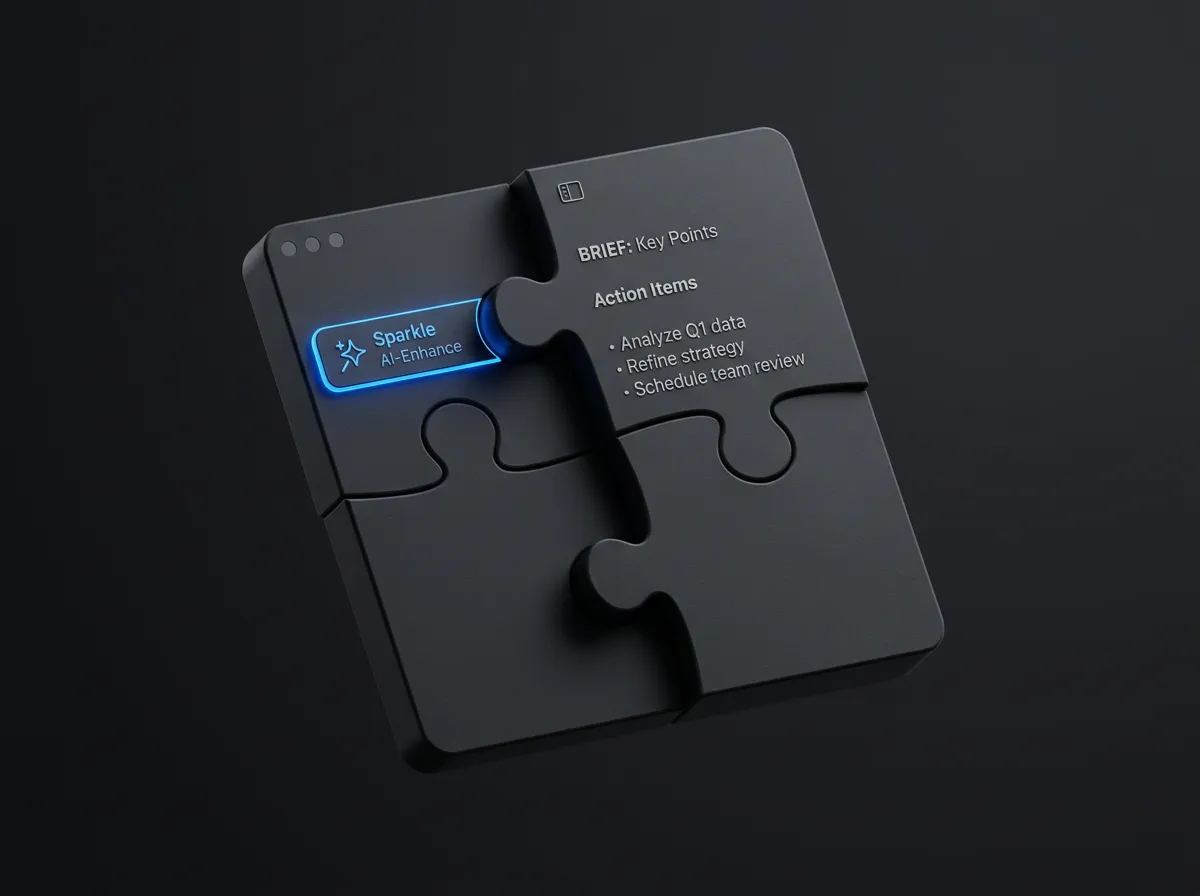
  • AI Enhance. Turns rough text into a brief, key points and action items, on-device.
  • Recipes & model picker. Inline note transforms; switch on-device ↔ cloud per note; move notes between folders.
  • More native touches. Quick Look, a real macOS context menu, and a faster Qwen3-VL vision model.

Flow & NotesLibrary & Lenses

Granola-style notes — illustration
PLATE · illustration, not a screenshot · Granola-style notes
0.16.0
Notarized
204 MB GitHub ↗

One bar to rule them

  • One mode-aware toolbar. Create, Flow and Canvas drop their own bars and share the shell.
  • Flow gets deeper. Real Snippets & Transforms tabs.

Flow & Notes

Unified shell — illustration
PLATE · illustration, not a screenshot · Unified shell
0.15.0
Notarized
204 MB GitHub ↗

Canvas moves under the shared toolbar

  • Canvas under one roof. The moodboard lives under the unified toolbar — board name + Add image/note inline.

Canvas & Create

Canvas, embedded — illustration
PLATE · illustration, not a screenshot · Canvas, embedded
0.14.0
Notarized
204 MB GitHub ↗

The unified shell

  • Single top toolbar. Mode-aware — Create & Flow embed below it, no bars of their own.
  • ⌘K command palette. Fuzzy-find every real action, keyboard-first.
⌘K command palette — illustration
PLATE · illustration, not a screenshot · ⌘K command palette
0.13.0
Notarized
204 MB GitHub ↗

Native macOS bars in Canvas, Studio and Notes

  • Native materials everywhere. Canvas, Studio and Notes pick up real macOS bars, accent and minimap.

Canvas & CreateStudioFlow & Notes

Native chrome — illustration
PLATE · illustration, not a screenshot · Native chrome
0.12.0
Notarized
204 MB GitHub ↗

System-Settings look

  • Settings, the macOS way. Accent-filled active tab, vibrant rail, native rows.
  • Every view to native tokens. Translucent bars, system accent — light-theme ready.
Light-ready — illustration
PLATE · illustration, not a screenshot · Light-ready
0.11.0
Notarized
204 MB GitHub ↗

The macOS redesign

  • A native shell. Hidden-inset titlebar, vibrant source-list sidebar, system-blue accent.
  • Tools sidebar. Library · Studio · Flow · Create · Canvas, each a mode (⌘1–5).
Native shell — illustration
PLATE · illustration, not a screenshot · Native shell
0.10.0
Notarized
204 MB GitHub ↗

A dictation guard, a sturdier menu, updates in Settings

  • Steadier everywhere. Dictation hallucination guard, a robust app menu, update controls in Settings.

Flow & Notes

Hardening — illustration
PLATE · illustration, not a screenshot · Hardening
0.9.0
204 MB GitHub ↗

Edit on your Mac

  • On-device image editing. Edit images locally with Qwen-Image-Edit (Apache-2.0).
  • Cloud by choice. Bring your own OpenAI key for gpt-image-1 generate + edit.
  • Honest downloads. Real progress in GB, a Hugging Face token for faster pulls, pause & resume.

Canvas & Create

On-device editing — illustration
PLATE · illustration, not a screenshot · On-device editing
0.8.0
204 MB GitHub ↗

The canvas grows up

  • Air-style canvas. Floating toolbar per image — Smart resize to every platform, on-device Tools (crop / flip / upscale / adjust), <b>/skills</b>, align & distribute, drag-in upload.
  • Default Create folder. Generate straight away — no folder to open; every render collects in one place.
  • Browser-style tabs. Open files & places in tabs, drag-reorder the sidebar, ⌘T / ⌘W.
  • Local Figma bridge. Push frames into your library, pull images + palette back — all on 127.0.0.1.
  • Refreshed onboarding. A 6-step tour of the whole product.

Canvas & CreateLibrary & Lenses

0.8.1Jun 19Opening the app twice no longer freezes it
  • One app, one window. If you open OY.Surf while it is already running, the window you already have now comes to the front. Before this fix, a second launch started a competing copy that fought the first over your library, and the app could freeze in the menu bar. It then disappeared from the Dock and from Force Quit.
  • A locked library no longer hangs the app. When your library is locked by something else, the app now waits up to 5 seconds and then gives up on that one request. Before, it could wait forever and freeze the whole app.
  • No canvas behind Flow, Create or Studio. Only one of the canvas, Flow, Create and Studio is open at a time now. Before, a strip of the canvas as wide as the sidebar could show through on the left.
Air-style canvas — illustration
PLATE · illustration, not a screenshot · Air-style canvas
0.7.0
204 MB GitHub ↗

Search matches by name and by meaning

  • Hybrid semantic search. Sqlite-vec vector index (100k+) + CLIP embeddings.
  • Best of both. Fused with lexical results (RRF) — matches by name <i>and</i> by meaning.
  • Always fresh. New images embed incrementally as they arrive.

Library & Lenses

Semantic search — illustration
PLATE · illustration, not a screenshot · Semantic search
0.6.0
204 MB GitHub ↗

Search inside your files; the sidebar stays put

  • Search by content. Matches AI descriptions, OCR text and notes — not just filenames.
  • Sidebar stays put. Visible across Studio, Flow, Notes and Create.

Library & Lenses

Search what’s inside — illustration
PLATE · illustration, not a screenshot · Search what’s inside
0.5.0
204 MB GitHub ↗

Instant indexing and an on-device library curator

  • Live render-watch. New files index the instant they land, with an arrival toast.
  • Auto-curator. An on-device model quietly describes your library for better search & Ask.

Library & Lenses

It keeps up — illustration
PLATE · illustration, not a screenshot · It keeps up
0.4.0
204 MB GitHub ↗

Moodboards, and cloud models on your own key

  • Moodboard canvas. React Flow — pan/zoom, captions, drag-connect, generate on the board.
  • OpenRouter BYOK. Bring your own key — on-device stays the free default.
  • Provider switch. Choose on-device or cloud everywhere AI runs.
  • Rich notifications. Image thumbnails + text snippets, click to jump to where it was made.

Canvas & Create

Boards & cloud-by-choice — illustration
PLATE · illustration, not a screenshot · Boards & cloud-by-choice
0.3.0
204 MB GitHub ↗

Search and tags hub, per-file lenses, Create

  • Search + tags hub. AI / text search with colour & smart-folder filters.
  • Settings, tabbed. Reorganised into a clean rail.
  • Per-filetype lenses. The right panel adapts to image / video / PDF / note.
  • Create. On-device image generation as a first-class surface.

Library & LensesCanvas & Create

Find & shape — illustration
PLATE · illustration, not a screenshot · Find & shape
0.2.0
244 MB GitHub ↗

Native navigation, a shortcut sheet, a new icon

  • macOS-native navigation. Back chevrons on pushed pages, Esc to dismiss.
  • Keyboard cheatsheet. ⌘/ anywhere; fully-rounded UI.
  • Recorder gallery. “Recent takes” as a poster-thumbnail grid.
  • New app icon. Pure-black squircle; PDF viewer fit fix.

StudioLibrary & Lenses

Native polish — illustration
PLATE · illustration, not a screenshot · Native polish
0.1.0
204 MB GitHub ↗

First release: a local-first library, Studio and Flow

  • Local-first library. Open any folder, browse in masonry or grid.
  • Lenses. Palette, OCR and info — read each file at a glance.
  • Studio & Flow. Screen recording and voice dictation, on-device.

Library & LensesStudioFlow & Notes

First release — illustration
PLATE · illustration, not a screenshot · First release